Lloyd Dobler Gallery is Permanently Closed
We will miss you.

"Years ago I had the pleasure of experiencing an intriguing exhibition at the Lloyd Dobler Gallery, an intimate apartment space cultivated by Patricia Courson and Rachel Adams, both alumni of the School of the Art Institute of Chicago. It was during this show that I encountered a striking piece that captivated my attention—a 9-inch cast iron skillet that effortlessly blended functionality with the raw beauty of nature. This particular skillet, crafted by Nest Homeware, boasted a handle meticulously designed to mimic the elegant form of a tree branch. Check it out. It was not just a cooking utensil but a piece of art that invited a dialogue between the object, its maker, and the observer. The skillet resonated with the gallery's ethos of highlighting emerging artists and collectives whose works are not only relevant to current contemporary art trends but also keen on engaging with the community. Recently discovering this skillet online was like stumbling upon a hidden gem that encapsulates the spirit of innovation and creativity that the Lloyd Dobler Gallery has been known for. It's bittersweet to acknowledge the closing of such a unique space that has offered so much to the artistic community. This gallery will undoubtedly be missed, but its impact on fostering contemporary art and dialogue will continue to inspire." Lamar Jones
For a number of years this was the website for the Lloyd Dobler Gallery in Chicago. In 2016 a post was made on their Facebook page announcing:
" Hi Chicago- LDG has taken a brief hiatus, but stay tuned as we will be back in some form or another. Thanks for all your support over the years!!
According to Yelpers the Lloyd Dobler Gallery is now permanently closed.
The content below is from the site's archived pages as well as from other outside sources. The new owners of this domain who attended a number of shows at the Lloyd Dobler Gallery want to thank Patricia Courson and Rachel Adams for all their passion and work.
Lloyd Dobler
1545 W. Division St., 2nd fl.
Chicago, IL 60622
Comment from Jason Tiller: Before he passed away, my uncle had a hugely successful show here because of all the hype around his personal life. His ex-wife had indicted for bank fraud and had not shown up for her court appearance. Her body was found in my uncle's back yard! So the papers had a field day with this. And all those stories started showing up when you searched his name in Google. You would think he was the murderer! He was appalled and sought help from some experts in removing damaging search results from Google. There actually are services that will hide a bad result in Google for a fee. They were super expensive, and he could not afford them, so he eventually decided to live with it. Google was damaging his reputation in his mind, but his art was taking off as a result. Crazy stuff.
LOOKING BACK
EXHIBITION: NEWS
One By One
An Exhibition of Buttons
Opening reception:
Friday, December 14th 6-10pm
Continues through January 19th
Regular hours: Tuesday and Thursday 5-9pm
Saturdays 12-5pm, or by appointment
Featuring over 50 artists across the country, 1"x1" buttons will be displayed on the gallery wall and there will be a grab bag of buttons for trading or to decorate the latest evolution of your messenger bag. The purpose of the show is to integrate the community in an interactive art exhibit that allows for conversation on the cultural fascination with buttons, designs will range from text based pieces to recognizable pop culture icons. Artists include Matthew Woodson, Sharlene King, Ellena Chmielewski, Kat Rhorbacher, Carrie Ruby, Mr. Gauky, Cayetano Ferrer, Ann Tarantino, Chelsea Wagner, Luke Drozd, Kristyna Baczynski, Christine Norrie, Christian Rieben, Julia Hechtman, Servando Garcia, Cody Hudson, Jason Lazarus, Pamela Staker, Greg Stimac, Jason Jozwiak, Isabel Urbina, Fox Mulder, Bert Stabler, Chris Roberts, Eric Guerrero, Rachel Adams and many others.
ArT hUnT 2007 - Tuesday, March 13, 2007
Lloyd Dobler Gallery is hosting its first art hunt on july 21, 2007. We are now taking submissions for participation in the hunt. the art hunt is part of lloyd's extending art into our communities. a description of the hunt is below: Ride bikes and roller blade in teams of two or three to find art installations near this Wicker Park gallery. All teams must visit at least six installations, photographing each with a gallery-provided Polaroid or their own. At the end, all photographs are displayed in the gallery. The first team returning with six finds wins. Happy Hunting! If you are interested in making a piece for our hunt, which will take place in the neighborhoods surround the gallery, please submit a description, a possible site or sites, and jpgs/drawings if you have them. anyone is welcome to submit to us. our email is lloyd@lloyddoblergallery.com deadline for submissions is: 06.15.07
(Un)Restricted Reviewed in Flavorpill - Thursday, March 8, 2007
"This exhibition's three artists blur the boundaries between figuration and abstraction in thrilling new ways. Ann Tarantino's performative "breath portraits" involve the artist blowing ink through a straw and embellishing the blobs with paint, resulting in creeping, plantlike forms; Christian Rieben's large-scale paintings suggest mysterious psychological landscapes with a wicked sense of humor (one piece in particular, Ass-Fixated, looks like a giant, blooming mum, but the title suggests other possible interpretations); and Dominick Garritano's bombastic, lushly brushed painting resembles a series of small, mosaic-like collages of geometric shapes and playful, vivid color." (AM)
Gallery hours - Thursday, March 1, 2007
Our regular viewing hours are Tuesday and Thursdays 5-9pm, or by appointment. Call us anytime at (312)961.8706.
Chicago Journal - Thursday, February 15, 2007
Lloyd Dobler makes waves with 'Coloring Outside the Lines' on front page of Chicago Journal.

Into the Mouth of the Wolf
March 14th - April 26th
Opening Reception:
Friday, March 14, 6-10pm
Lloyd Dobler Gallery is pleased to announce the opening of the spring gallery season with the multi-media group exhibition Into the Mouth of the Wolf. Featuring new and recent works by Matt Carr, Ian Hokin, Brendan Larsen, Dawn Kasper, Helena Kvarnstrom, Matthew Woodson and Xela.
When one thinks of the word horror, most likely a scene from your favorite cult-film classic featuring visions of Freddy, Jason Voorhees or an axe wielding Jack Nicholson will pop into your head; often accompanied by a shudder or grin (depending on your cult follower status). But, not everything relating to the word horror has to do with slasher movies or George Romero? latest spin on the undead with their shuffling walk and foaming mouths. We as an audience are often bombarded by horrific imagery in daily news outlets and television programming from the war in Iraq to the genocide in Darfur; it becomes increasingly important to discover new avenues for dealing with this violent imagery through culturally relevant practices. Into the Mouth of the Wolf is an exhibition that examines the use of frightening imagery in contemporary art ranging from fantasy to realism in painting, drawing, performance, photography and sound works.
The artists in this exhibition portray horror in classic and innovative ways, what frightens one person will make the next person laugh or possibly scoff in repugnance. The show focuses on different ideas of horror in today's art practices and investigates its role in today? society. What do you find frightening? The classic horror movie genre is so familiar that people seem to take it for granted, but its influence on contemporary art is astounding. The seven diverse artists in this exhibition all reference the genre in various ways, whether it be performing their death, experiencing a haunting, or working with the absurd.
Matt Carr lives and works in the Chicago area, he received his BFA from The School of the Art Institute of Chicago. He works as a free-lance designer and has designed cover art for such bands as Blood Freak, Frightmare, Fondle Corpse, Ghoul, Razorback Records, Impetigo, Cardiac Arrest, Plerosis, Bowel Stew and Sakatat.
Ian Hokin is a Chicago based painter that received his BFA from The School of the Art Institute of Chicago. He has exhibited at Roots and Culture Contemporary Art Center in Chicago, The General Store in Milwaukee and performed with Scott and Tyson Reeder for Gavin Brown Enterprises.
Dawn Kasper is a Los Angeles based performance and mixed media artist actively investigating existing and created emotional structures. She has performed at the Migros Museum F? Genenwartskunst in Zurich, Switzerland, the J. Paul Getty Museum, Art Positions: Art Basel Miami Beach, shown video at Art in General in New York, sculpture at Raid Projects, installation at Anna Helwing Gallery, and photos at Circus of Books Gallery in Los Angeles. She is represented by Circus Gallery in Loa Angeles.
Helena Kvarnstrom was born in Sweden and currently lives and works in Toronto. She received her MA from the University of East London in 2005. She has exhibited work at Receiver Gallery in San Francisco, Renowned Gallery in Portland, Subliminal Projects in Los Angeles, Pearlfisher Gallery in London; amongst others.
Matthew Woodson lives and works in Chicago, he received his BFA from The School of the Art Institute of Chicago. He has provided illustrations for NewYork Magazine, Ford, Threadless, Penthouse Magazine, The Boston Globe, American Express and others.
Xela (John Twells) lives and works in the UK. Xela is one of the co-founders of Type Records. He was signed by Neo Ouija records to release his debut album 'For Frosty Mornings And Summer Nights', since then he has released a follow-up on the City Centre Offices label, and also a collaboration with Type Records artist Logreybeam, under the Yasume moniker.
Review: Pictures of Nothing/Lloyd Dobler Gallery
DECEMBER 9, 2008 AT 12:26 PM BY ART EDITOR | https://art.newcity.com/

Philip Vanderhyden
RECOMMENDED
Five artists working within the often hard-to-qualify region of abstraction create an incredibly potent phenomenon at Lloyd Dobler with “Pictures of Nothing.” The gallery can barely contain some of the work on its walls, especially Philip Vanderhyden’s powerful color field studies which seem to literally breathe, pressed up and out from the very edges of the canvas. They have a pulse and depth surpassing much of the work around them, though Michael Anthony Simon’s wood blocks with black squares are so effective precisely because of how difficult they are to focus on. One black square occupies a different position on each wood block, seeming to point at the overlapping shadows on the wall beyond them, calling into question exactly what Simon’s art might be. Is it the sculpture or the space from which it is hewn? John Opera’s addition to the show is small but carries itself well, an archival inkjet print of dense black in which a spray of gold describes yet another black square, almost floating out beyond its frame. The piece resembles a postmodern religious artifact courtesy of Xerox. The show as a whole calls to mind the progression of the works of genius Robert Irwin, from simple abstract statements to highly focused phenomenological questions, and may be the finest Lloyd Dobler has mounted yet. The small gallery has already been around for more than two years, so maybe it’s safe to hope that they will survive and thrive and someday offer a show of these same artists in a larger space, a show overwhelming enough to really knock you out of your skin and into some kind of nothingness for just a moment. An abstracted frame of mind might be the best vantage from which to view these great works. (Damien James)
“Pictures of Nothing” shows at loyd Dobler Gallery, 1545 W. Division, second floor, though January 3.
January Gallery: Mr. Lloyd Dobler has the tightest schedule
Opening Reception: January 31, 2009 7-10pm
"I don't want to sell anything, buy anything, or process anything as a career. I don't want to sell anything bought or processed, or buy anything sold or processed, or process anything sold, bought, or processed, or repair anything sold, bought, or processed. You know, as a career, I don't want to do that." -Lloyd Dobler
"I have this theory of convergence, that good things always happen with bad things. I know you have to deal with them at the same time, but I just don't know why they have to happen at the same time. I just wish I could work out some schedule." -Diane Court
JANUARY gallery will be the fifth of Twelve Galleries that show the work of emerging artists and intellectuals over the course of on year. With each new month, a new location is selected, and a new gallery is formed. Each gallery's exhibition life is just one month. In collaboration with Lloyd Dobler Gallery, JANUARY Gallery will emphasize Chicago spaces and situations in relation to art. The audience, with Mr. Lloyd Dobler's helping hand, will author the work in this exhibition by participating in the making of a schedule that reflects their hopes and prophesies for what will come in the next year of Chicago's art scene.
As part of JANUARY Gallery, Lloyd Dobler will host its winter lecture series:
February 4, 2009 7pm - James Kao
Case-By-Case Basis
March 6 - April 11, 2009
Opening Reception: March 6, 7-9pm
Artists' Reception during SGC: March 27, 9-11pm
Lloyd Dobler Gallery is pleased to announce Case-By-Case Basis, featuring the print and mixed media work of Diana Behl, Alex Chitty, Regan Golden-McNerney, Joe Hardesty, Noah Hyleck, Jeremy Lundquist, Amanda Repo Taiwo Thomson, and the collaborative work of Ryan McMurran and Shira Soskel.
The exhibition will open with a reception on Friday, March 6 from 6-10pm. An additional artistsÕ reception will take place on Friday, March 27 from 9 to 11pm, coinciding with the Southern Graphics CouncilÕs Conference, hosted by Columbia College with events throughout Chicago (for more information visit www.colum.edu/sgc).
The work gathered for Case-By-Case Basis will address instances where the relationship between an individual and an institution are in flux. The collaborative work of Ryan McMurran and Shira Soskel explores the very action of representing the complexity of contemporary society. Their work is based in a systematic, non-hierarchical theory that by design seeks to be inclusive of multiple cultures and traditions. This search for understanding is taken into the realm of science by Alex Chitty, who refers to herself as both an artist and biologist. Her recent prints appropriate old illustrations in print of fauna but leave out the representation of the main subject, the animals. In addition a new title is given pushing the work back into scientific-like attempts to collect, preserve, document and decipher the world.
Diana BehlÕs acts of documentation question our quotidian relationship to the world around us. The works delve into how emotions are at play with verification while the question of emotion in Regan Golden-McNerneyÕs work places us on the edge or right in the middle of an abyss of perception. Cut paper and carefully articulated patterns beg for an understanding of our History and of the places we inhabit. Amanda Repo Taiwo Thomson brings the concept of place and home to the forefront, questioning the very constructions that our society builds upon. Landscapes, maps, and text are brought together by Thomson to elucidate our response to where we are.
Noah Hyleck explores who we are to each other. Small, careful considerations of the interactions between people are found in his drawn, collaged and printed works. These examinations of specific connections between individuals can provide insight into the act of communication in society Ð what is normal and what is awkward? Joe Hardesty brings the connection between individuals squarely to the artist/viewer relationship. Drawn text describes representation in his work as the viewer is left to fill in even more specifics. The work of Jeremy Lundquist also gives the viewer a challenge to fill in what is missing. In these works, information is truncated, re-routed and composed with bare intention. The consideration of facts and lies are laid out in a progression that questions the very construction of meaning, knowledge, and history in our society.
The collected works of these artists will test how consideration of the individual on a case-by-case basis in todayÕs society can improve and impede our lives. Diana Behl lives and works in Brookings, SD. She received her MFA from the University of Iowa in 2005. Selected exhibitions include: Sioux City Art Center, Lux Center for the Arts (Lincoln, NE), Soo Visual Arts Center (Minneapolis) and the International Print Center New York.
Alex Chitty lives and works in Chicago, IL. She received her MFA from the School of the Art Institute of Chicago in 2008. Selected exhibitions include: ATC Gallery (Chicago,), Zhou B Art Center (Chicago), RIDER Project (Chicago), Sitka Center for Art and Ecology (Otis, OR), and The Horticultural Society of New York. For more information visit www.alexchitty.com.
Regan Golden-McNerney lives and works in St. Paul, MN and Chicago, IL. She received her MFA from the University of Wisconsin Ð Milwaukee in 2006. Selected exhibitions include: Walker Art Center (Minneapolis), Cue Art Foundation Gallery (New York), Gallery 400 (University of Illinois at Chicago), Brooks Barrow Gallery (Milwaukee), and the WalkerÕs Point Center for the Arts (Milwaukee). For more information visit www.drawnlots.com/regan.
Joe Hardesty lives and works in Berlin, Germany and Chicago, IL. He received his MFA from the School of the Art Institute of Chicago in 2008. Selected exhibitions include: Western Exhibitions (Chicago), Devening Projects (Chicago), Galerie Lifebomb (Berlin), and The Soap Factory (Minneapolis). For more information visit www.joehardesty.com.
Noah Hyleck lives and works in Brooklyn, NY. He received his MFA from Ohio University in 2002. Selected exhibitions include: Hjemkomst Cultural Center (Moorhead, MN), Makeready Press (Montclair, NJ), Fleckenstein Gallery (Towson, MD), Nash Gallery (University of Minnesota), Lancaster Museum of Art (PA), and the Ostrobothnian Museum (Vaasa, Finland)
Jeremy Lundquist lives and works in Chicago, IL. He received his MFA from Ohio University in 2003. Selected exhibitions include: Gallery 2 (the School of the Art Institute of Chicago), WalkerÕs Point Center for the Arts (Milwaukee), 400 Gallery (University of Illinois at Chicago), Nash Gallery (University of Minnesota) and the Chicago Cultural Center. For more information visit www.drawnlots.com/jeremy.
Amanda Repo Taiwo Thomson lives and works in Glasgow, Scotland. She received her MFA from the School of the Art Institute of Chicago in 2008. Selected exhibitions include: Western Exhibitions (Chicago), OÕConnor Art Gallery (Dominican University, River Forest, IL), For more information visit www.passingplace.com.
Ryan McMurran and Shira Soskel received their BFAs from the School of the Art Institute of Chicago in 2008. Selected exhibitions include: Gallery X (the School of the Art Institute of Chicago), Galerie Lifebomb (Berlin), and the Moser Gallery (University of St. Francis, Joliet, IL). For more information visit www.mcmurran-soskel.com.
THE GALLERY CRAWL AND SO MUCH MORE...
Stardate: March 6th, 2009 | thegallerycrawlandsomuchmore.blogspot.com
I made my second pilgrimage to Lloyd Dobler, pausing momentarily outside to hold my boom box aloft, to see something they were calling “Case-By-Case Basis.” I was initially attracted to the event by my previous memory of the place (“Oh yeah,” says my brain, “that's the awesome apartment gallery I saw John Opera lecture at.”) and partially because I recognized a buddy's name on the line up (Joe Hardesty, who, unfortunately, wasn't there, he's out of the country right now doing art or some such crap). After looking over the show, I decided that the show in particular, and Lloyd Dobler in general, consisted of fine stuff. The show, which consisted primarily of printmaking, was on the whole strong, well curated, and enjoyable to look at. And, of course, the people who run the place are great, hospitable, and giving of their back room for jacket storage, and their beer (sorry if the micro brew wasn't supposed to get drank BTW). After hanging out there for about an hour, Jeriah and I left, with the assumption that we were going to go find more art, then head to David's. Instead, we were sucked in by the Blue Line (the bar, not the transit), stuffed our faces with tasty food, and headed home in a total food coma. Mmm...
Review: Middleground/Lloyd Dobler Gallery
JUNE 15, 2009 AT 11:58 PM BY ART EDITOR | https://art.newcity.com/
/
Jerome Acks
RECOMMENDED
Artists constantly deconstruct and dissect their subjects, reducing them to digestible form or examining them in minute detail, and sometimes it amazes us. Sometimes when we see something broken down, our understanding of how it works improves, and our appreciation is reinforced. Other instances yield unexceptional work that seem to require a master’s degree to unlock and access. The four artists participating in “Middleground” do, in fact, all have undergraduate or graduate degrees from the School of the Art Institute, but fortunately for their audience, what they offer is not only intellectually accessible, but often incredibly appealing for the eyes.
Andrea Myers’ “Fold Unfold” humbly greets you as you enter, with piles of multicolored fabric on the ground stacked largest to smallest. The fabric implies paint stripped from the canvas piece by piece, a literal dissection; the hues on the floor are the brightest you’ll see in the show, as if any pretense and performative flash has been cast off before you have a chance to allow preconceived notions to settle. If you follow Myers’ fabric along the hardwood floor you’ll be lead to her other contribution, two small rectangles of multi-layered paper on the wall, each with central sections peeled away, again from largest to smallest. Exposed layers yield their own slight colors and nearly recede right through the wall. They invite you to get close, to look at the individual fibers of paper swaying in the air where they gave way to the violence of removal.
“Inside Out” by Jerome Acks looks to Mondrian, baring its unstitched and taped underbelly, its loose strings also swaying, casting shadows. It reads like the backside of a nearly complete work, still being formed, refined, which is what makes it so compelling. The work calls to mind the unclarified idea, the still evolving tools with which we communicate pictorially. All four artists use a direct and economical language. With minimal effort, they ask what it is to make art, and by offering their own notes on the process, we can see the literal steps they take toward answering that question. (Damien James)
Through July 25 at Lloyd Dobler Gallery, 1545 W. Division, second floor.
/images/aliza_morell.jpg
Pastoral Disruption
New work by Michelle Bolinger, Eric Ramos Guerrero, Aliza Morell
December 17, 2010 - January 29, 2011
Opening reception: Friday, December 17, 2010 6-10pm
HACK: Pictures From A Chicago Cab
Dmitry Samarov
October 14 - November 19, 2011
Reception: Friday, October 14, 6-10pm

Lloyd Dobler Gallery is pleased to present the solo exhibition Hack: Pictures From A Chicago Cab, new and recent paintings by Chicago artist and writer, Dmitry Samarov.

The work in this exhibition integrates the drawings and paintings Samarov has done in and about driving a taxi in Chicago, along with stories from his recently published book, Hack: Stories From a Chicago Cab (University of Chicago Press, 2011). Part of the series is comprised of gouache paintings of cabs that were completed on site at O'Hare and Midway Airports. Other works show a variety of illustrations from the book, as well as the blog http://www.chicagohack.com/) that inspired it. The pieces range from caricatures of memorable passengers, to depictions of blizzards, to the city's nighttime streets.
Dmitry Samarov was born in the Soviet Union and immigrated to the United States in 1978. He earned his BFA in painting and printmaking at the School of the Art Institute of Chicago in 1993 and began driving a cab that same year. His work has been shown at the Chicago Tourism Center, the Merchandise Mart, the Bowery Gallery, and Brandeis University. Samarov is the creator of the blog Hack, stories from which have been featured in the Chicago Reader and elsewhere.

Four for Fall
by Claudine Isé | http://magazine.art21.org/
Sep 28, 2010
Traditionally, fall is the time when galleries launch their new slate of exhibitions after a relatively slow-paced couple of summer months. Galleries tend to highlight some of the most prominent artists on their roster around this time, but it’s also common to use the Fall slot to introduce promising new up-and-comers. In Chicago, at least, all the hoopla around the fall openings (many of which took place on a single night several weeks ago) can feel a lot like a high school pep rally: the anticipatory fall preview lists and gallery guides, the minutely detailed gallery crawl maps and the inevitable “best of” Tweets that follow are ways of rousing ourselves from the complacencies of summer in order to get psyched for the upcoming art season.
All hype notwithstanding, fall invariably works its magic on me. I struggle with lazy gallery-going during the summer (and, let’s be honest here, sometimes during springtime too) yet feel a sense of urgency about seeing everything once September rolls around. I’m pleased to report that my efforts have been richly rewarded this season. There are so many interesting shows, and quite a few really excellent ones, taking place in Chicago right now there simply isn’t space to do justice to all of them here.
.........

Dan Gunn, "Multistable Picture Fable," 2010.Acrylic, enamel, glitter, glue, colored pencil, plexiglass, ribbon, furniture, basket, lycra, marbles, on plywood, panelboard, particleboard and wood with hardware.Dimensions variable, approx. 8' x 15' x 6'. Courtesy the artist and Lloyd Dobler Gallery, Chicago.

Dan Gunn, "Multistable Picture Fable," 2010 (detail).
Like Wendy White, Chicago artist Dan Gunn makes objects that challenge normative ways of looking at a flat surface. Gunn’s extravagant, enveloping installations aren’t paintings, although I find it perversely pleasurable to think of them in precisely those terms. Titled Multistable Picture Fable, Gunn’s small solo show at Lloyd Dobler Gallery consisted of a sculptural environment composed of individual flat panels of various materials and sizes that are hinged together like doors, fences, or, to my mind, run-on sentences.
Multistable Picture Fable makes me think of makeshift wooden forts and secret hideaways. The installation must be walked around (and around and around) in order to be apprehended. At one point, the hinged panels seem to rise up and swirl around your body, creating an inviting private alcove that encourages the kind of intimate consideration of form and surface that institutional art presentations, with their warning signs and “don’t touch!” admonitions, hardly ever allow. Each panel is wildly different from the next: some are painted, some have paintings affixed to them; some are curtained by fabric, others are stained or left bare, the better to show off the integrity of the original surface. The panels echo each other and converse, and invite you to do the same. If, for argument’s sake, we do choose to view these objects as paintings, we find distinctions between inside/outside, back/front, surface/support becoming unstable and ultimately losing their grip on us entirely. They’re exposed as fictions, or “fables,” as rules that are meant to be broken.
........
Lloyd Dobler: Carl Baratta

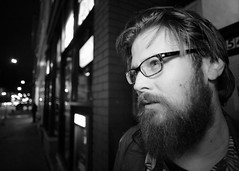
9:21 PM, Friday, March 2, 2012:
I catch painter Carl Baratta on the sidewalk: he's rolling cigarettes, standing near to the staircase leading up to the second-floor gallery. While Baratta is occupied with other people (as many people begging tobacco as complementing his show) I set-up the camera, flash and diffuser. Ready, I approach and find him to be a willing subject. In spite of the falling temperature, increasing wind, and steady crowd of friends and fans, his patience allows for twenty good shots. James Kao chats with us for a few minutes, outside; Samantha Bittman chats for a few minutes, inside. Bittman lets me know that I sound like I'm from Brooklyn, New York. No worries.
In the apartment gallery's kitchen, at the end of regular hours, apropos of nothing, I broach the subject of Chicago art fairs with Lloyd Dobler proprietors Patricia Courson and Jason Jozwiak. Maybe: (a) I remember seeing them (Patricia and Jason) at NEXT in 2010, near Saul Aguirre; and, (b) NEXT was recently cancelled? No beer; a few quick pics inside; I'm out.
Carl Baratta
March 2 - April 28, 2012
Lloyd Dobler Gallery
1545 W. Division, Second Floor
Chicago, IL 60642
Into the Fold
New Work by: Michelle Bolinger
Opening Reception: Friday, February 7, 2014 6-10pm
Through painting, Bolinger intends to challenge our perception of space and environment. She has sourced the landscape and her surroundings for many years with references ranging from grand scenes to small elements.
Michelle uses these kinds of observations to create abstractions that have a similar sense of play and confusion. The familiarity, established through her observations of the real world, help make the work to be more easily absorbed by the viewer.
Michelle Bolinger received her MFA from the University of Washington in 2005, and her BFA from Indiana University in 2003. She has had solo shows at Francine Seders Gallery in Seattle, WA, The Presidents Gallery at Harold Washington College and DIG, both in Chicago, IL. In addition, she has shown at Roots and Culture Gallery and The Swimming Pool Project Space in Chicago, and The Henry Art Gallery and Crawl Space, both in Seattle, WA. She has been awarded grants from the Illinois Arts Council and the Chicago Artists Assistance Program. She has taught at Northwestern University, Loyola University and Lake Forest College and was Visiting Professor & Artist in Residence at the University of South Florida in the Fall of 2012.
Kaylee Rae Wyant: The Spoon River
Lloyd Dobler Gallery
1545 W. Division St. 2nd Flr.
Wicker Park
Opening reception September 10th, 6-10PM
Closes October 8th
Lloyd Dobler Gallery is pleased to present Kaylee Rae Wyant in her first solo exhibition with LDG . Wyant’s paintings and sculptures use sensory contact to assert a sense of presence in her work. Exploiting various direct applications ranging from thin washes and finger painting, to layers of paper-mache and collage, her personal employment of technique is evident throughout the work. Wyant treats her surfaces with a frankness and economy that borders on the pragmatic. Each move is spontaneous, yet remarkably deliberate. The Spoon River presents a combination of works that slide between different states of functionality. Wall paintings mingle with hand-held paper sculptures that rest upon custom wooden benches, inviting multiple interactions from the viewer. The benches, which line half the gallery and are hand-finished in paper-mache, provide several vantage points- whether traditional or experimental, the pieces are always drawing attention to proximity and juxtaposition. For Wyant, these physical aspects of viewing are an important, if not more so, than the individual works.
Review: Edra Soto/Lloyd Dobler Gallery
OCTOBER 18, 2014 BY MATT MORRIS | https://art.newcity.com/

Edra Soto. “Say Everything,” 2014,
installation view at The Lloyd Dobler Gallery
mixed Media (flags, fans, plastic chairs, beach towels, tape, sand, cooler, pink light, latex paint)/Photo: Michael Soto
RECOMMENDED
Unlike the fictional lead character, Lloyd Dobler, of the eighties teenage classic “Say Anything,” Soto’s rebellious carefree attitude in “Say Everything” is the result of mature and considered thinking, a deliberate expression of the ambiguous nature of desirable objects, and the figurative and administrative commonwealth.
Five verdant flags flutter in the gently constructed breeze issuing from brightly painted red fans that are variously standing or clipped to plastic lawn furniture upholstered with tiger-faced beach towels. A pink cooler, encrusted and filled with glittering pink sand, rests on a short floor-level plinth. Silver tape on the windows mimics the patterns of Puerto Rican fencing screens, a frequent subject for Soto, slicing the evening light into shadows that echo the patterns on the flags.

Edra Soto. “Say Everything,” 2014,
installation view at The Lloyd Dobler Gallery
mixed Media (flags, fans, plastic chairs, beach towels, tape, sand, cooler, pink light, latex paint)/Photo: Michael Soto
The forms of the furniture, fencing and fans fuse into the domestic setting of the second-floor apartment gallery, while the sense of fabricated idealism is emphasized through the bold use of color. Garish pink lighting falling on salmon painted walls creates the illusion that the light outside the gallery space is green, as well as emphasizing the green of the semi-transparent window-sized flags.

Edra Soto. “Say Everything,” 2014,
installation view at The Lloyd Dobler Gallery
mixed Media (flags, fans, plastic chairs, beach towels, tape, sand, cooler, pink light, latex paint)/Photo: Michael Soto
Soto created the patterns of diffracted, geometrical stars and stripes resembling the US, Puerto Rican and Chicago flags in Captiva, Florida at the Rauschenberg Residency. Inspired by the tropical plants on the residency grounds, she used them as the basis for a collage that she photographed and digitally reassembled. The plants also correspond to those that she regularly sees but is forbidden to touch at the Garfield Park Conservatory near her home. The relationship of these locations, all places she has lived—Puerto Rico, Chicago and the wider USA—is addressed through a representation of access to a way of life considered beautiful and desirable.
After years of cautiously avoiding direct confrontation with the subject of patriotism, Soto confronts its iconic image through the kind of superlative idyll that flags represent: a constructed non-place, leaving room for the influences of fantasy, access and imagination. The imitation summer set within a second floor apartment overlooking Polonia Triangle will fittingly be up through early December. (Alyssa Moxley)
Through December 12 at Lloyd Dobler Gallery, 1545 West Division. Saturday hours by appointment through contacting lloyddoblergallery@gmail.com .